Founder & CEO
Jan-Willem Rombouts
An academic friend of mine came back from holiday with a startling disclosure. In 10 days, using only Claude prompts, he had rebuilt and improved a sophisticated grid model his team had spent months building. He then started musing about what that means for PhD and postdoc staffing, the same off-guard reckoning I keep seeing from very smart people surprised by AI. There is indeed just too much intelligence for us to handle these days. We are linearly adapting creatures catching up with exponential change.
That same week, I met with grid operators sharing their latest data on the interconnection queue, that dreadful waiting line where data centres, batteries and electrifying factories are stuck trying to connect to the grid. More than 2,000 gigawatts of generation and storage is stuck in the US queue alone. The same bottleneck is now forming across Europe. Suddenly I was in a world of scarcity: scarcity of computational tools, scarcity of wires, of transformers and other grid components; scarcity of generation capacity.
As abruptly as abundant intelligence emerged, we are living in an age of power scarcity. Every token traded rests on an electron traded first. So, is there a power curve that can catch up with the intelligence curve?
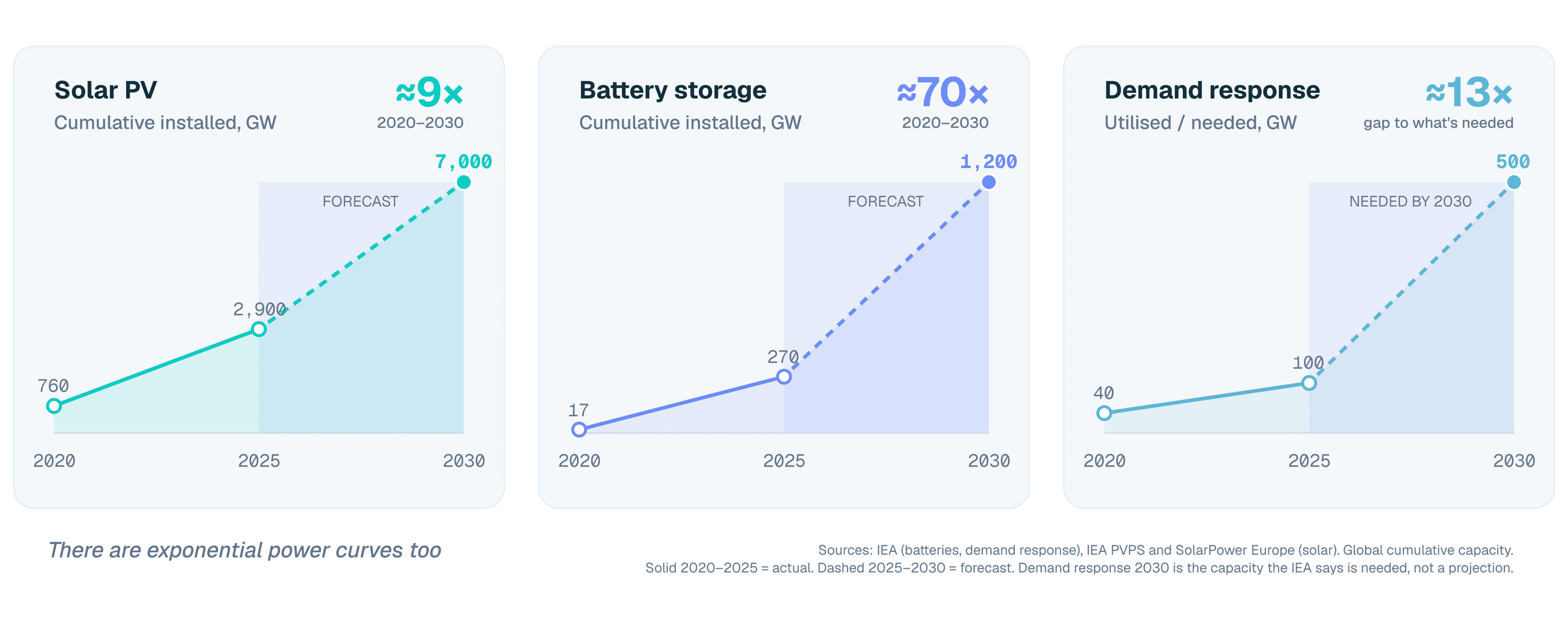
Problem solved. Almost. A few details remain. If this exponential growth of flexible resources is to supply the growth of intelligence, we need to connect the dots. Literally, from a power grid perspective, capacity at one point needs to be able to support demand at another. This is what "Bring Your Own Capacity" (BYOC) entails: an emerging procurement model where large loads fund or aggregate nearby distributed energy resources to offset their own grid footprint and, in careful agreement with grid operators, reach power faster.
Three bottlenecks, three opportunities:
Regulation and market design to enable major efficiencies:
The legal scaffolding already exists: FERC Order 2222 in the US and the EU's Clean Energy Package both encourage an open market to aggregated distributed resources across the grid. The gap is not the principle but the pace of implementation, so that anyone, anywhere in the grid, can support anyone else, at any time. For BYOC, that means developing standardized congestion products available to flex providers at all voltage levels.
Grid modelling meets edge modelling to enable grid planners:
Most grid planners don’t know where DER or industrial load flexibility sits, don’t have a good model of it, let alone have to integrate it into their power flow analysis and planning tools.
Seamless models of the edge, and simple tools to detect, value, and integrate into existing planning workflows.
Customer flex proposition adoption to enable users:
Any user should be able to access any value stream in the system. We see BYOC aggregators, innovative energy suppliers and traders as key to enabling these propositions funded by data centres (or any other large load for that matter).
As we overcome these bottlenecks, what do we end up with? The exponential curve of distributed energy production and storage, and the exponential curve of customer adoption, will start to track the exponential growth of AI compute and large load.
This certainly looks far better than the alternative: building loud, polluting gas peakers next to people's houses to meet that demand.
Beebop is building the infrastructure to enable that.


CASE STUDIES
As electrification and renewable energy supply grows, the deep integration of consumer devices into the power system is a key success factor for the energy transition. Read more about how we make it happen.